
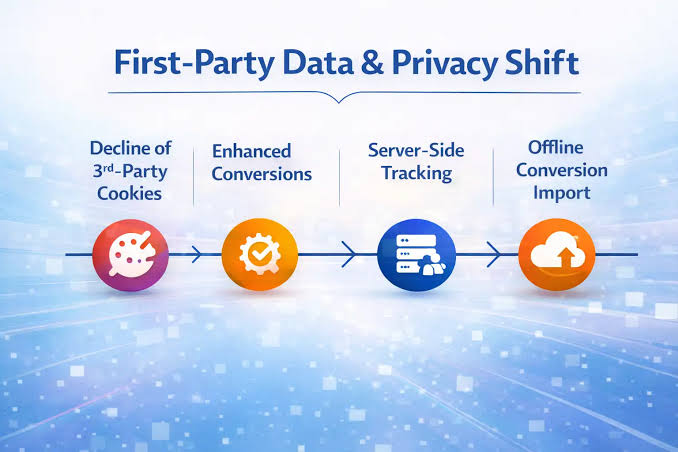
For years, digital marketers relied heavily on third-party cookies and tracking technologies to understand online users and show them targeted advertisements.
But the digital advertising landscape is changing.
People are becoming more conscious about how their personal information is collected and used. At the same time, browsers, platforms and regulators are introducing changes that are forcing businesses to rethink how they collect and use customer data.
This has made first-party data one of the most important topics in digital marketing.
Instead of depending entirely on information collected from outside sources, businesses are increasingly focusing on data that customers voluntarily share directly with them.
This includes information from websites, apps, purchases, email subscriptions, loyalty programs, customer accounts, surveys and direct interactions.
The shift is bigger than simply replacing cookies.
It represents a move toward building stronger and more transparent relationships with customers.
What Is First-Party Data?
First-party data is information that a business collects directly from its own customers or audience.
For example, imagine you own an online clothing store.
A customer visits your website and:
- Creates an account
- Purchases a dress
- Signs up for your newsletter
- Adds products to a wishlist
- Answers a style quiz
- Contacts customer support
The information collected through these interactions can become first-party data.
Because the information comes directly from the customer’s interaction with the business, it can be extremely valuable for marketing.
Examples of first-party data include:
- Name
- Email address
- Purchase history
- Product preferences
- Website interactions
- Loyalty activity
- Customer service interactions
- Subscription information
- Survey responses
- Shopping preferences
However, collecting data does not automatically mean a business should use all of it.
The way data is collected, stored and used matters just as much.
First-Party Data vs Third-Party Data
Understanding the difference is important.
First-Party Data
Collected directly by your business from your own customers and audience.
Example:
A customer signs up for your newsletter.
Second-Party Data
Another organization’s first-party data that is shared with your business through a partnership or agreement.
Example:
Two businesses collaborate and share selected customer insights under an appropriate agreement.
Third-Party Data
Information collected from multiple external sources and typically made available by another company.
Historically, third-party data and cookies played a significant role in digital advertising and audience targeting.
But increasing privacy concerns and changes in the technology ecosystem have made businesses rethink their dependence on this type of data.
Why Is First-Party Data Becoming More Important?
The biggest reason is control.
When a business collects its own customer data, it has a direct relationship with the source.
For example, a restaurant that operates its own loyalty program can understand customer preferences through direct interactions.
An e-commerce company can learn from purchases and website behavior.
A beauty brand can understand product preferences through customer accounts and surveys.
This information can help businesses make better decisions.
Instead of asking:
“Who might be interested in my product?”
the business can start asking:
“What have my existing customers actually shown us that they need?”
That can lead to much more relevant marketing.
The Difference Between First-Party and Zero-Party Data
Another term that marketers should understand is zero-party data.
First-party data is information a business observes or collects through customer interactions.
Zero-party data is information that customers intentionally and directly provide about themselves.
For example, a customer might answer:
“What type of skincare are you interested in?”
and choose:
- Acne care
- Hydration
- Anti-ageing
- Brightening
That is zero-party data because the customer has deliberately told the brand what they want.
This type of information can be particularly useful for personalization.
What Is Personalized Marketing?
Personalization means tailoring marketing messages or experiences based on information about the customer.
Think about the difference between these two emails:
Generic:
“Check out our latest products.”
Personalized:
“Since you recently purchased a skincare cleanser, here are three moisturizers that may work well with it.”
The second message is more relevant.
Personalization can appear in:
- Emails
- Product recommendations
- Website experiences
- Advertisements
- SMS
- Loyalty programs
- Offers
- Content recommendations
The goal is not simply to insert someone’s name into an email.
Real personalization is about making the experience more relevant.
Why Personalization Matters
Customers are exposed to an enormous amount of marketing every day.
If every business sends exactly the same message to everyone, it becomes difficult to get attention.
Personalization can help businesses communicate more effectively by focusing on what is relevant to an individual customer or customer group.
For example, an online fashion store could recommend winter clothing to customers who are shopping for cold-weather destinations.
A travel company could promote family holidays to customers who previously booked family packages.
A coffee brand could offer a discount on a customer’s regularly purchased product.
These experiences can feel more useful than random promotions.
Personalization Does Not Mean Being Creepy
There is an important line between useful personalization and uncomfortable personalization.
Imagine a customer looks at a product once and suddenly receives advertisements everywhere for the next two weeks.
The customer may not find that helpful.
They may instead feel that they are being watched.
This is why privacy needs to be part of personalization.
A good marketer should always ask:
“Would the customer understand why they are receiving this message?”
If the answer is no, the strategy probably needs to be reconsidered.
Privacy-First Marketing
Privacy-first marketing means building marketing strategies around transparency, responsible data collection and customer choice.
Instead of collecting as much information as possible, businesses should think about collecting the information they genuinely need.
For example, if a newsletter only needs an email address, there may be no reason to ask for a customer’s date of birth, address and phone number.
The principle is simple:
Collect what you need. Explain why you need it. Use it responsibly.
This can also help build trust.
Consent Is Becoming More Important
Customers should understand when they are providing information and how it will be used.
For example, a website might allow customers to subscribe to marketing emails.
The customer should be able to understand what they are signing up for.
Consent should not be hidden inside complicated language that people cannot reasonably understand.
For marketers, this means privacy cannot simply be treated as a legal or technical issue.
It is also a customer experience issue.
The Role of CRM in First-Party Data
Customer Relationship Management, or CRM, systems have become increasingly important in first-party data strategies.
A CRM can help businesses organize information about customer interactions.
For example, a business might have information showing:
Customer A
- Purchased twice
- Interested in skincare
- Opened recent emails
- Has not purchased in three months
Customer B
- First-time customer
- Purchased a gift
- Responded to a discount
- Has not subscribed to email
These customers should probably not receive exactly the same marketing message.
CRM systems can help marketers create segments and communicate with customers more effectively.
Customer Segmentation
Customer segmentation means dividing an audience into groups based on shared characteristics or behaviors.
Common segmentation methods include:
Demographic Segmentation
Based on characteristics such as age or location.
Behavioral Segmentation
Based on actions such as purchases, website visits or email interactions.
Geographic Segmentation
Based on location.
Purchase-Based Segmentation
Based on products purchased, order frequency or spending.
Engagement-Based Segmentation
Based on how actively customers interact with a brand.
Segmentation allows businesses to move away from the idea that one marketing message should work for everyone.
First-Party Data and Email Marketing
Email marketing is one of the clearest examples of first-party data in action.
When someone voluntarily subscribes to a company’s email list, the business has a direct communication channel.
The company can then send useful content based on customer interests.
For example:
A jewellery brand could send new collection updates.
A travel company could send destination guides.
A beauty brand could send skincare tips.
An online education company could send learning resources.
The important word is useful.
People are unlikely to stay subscribed if every email is simply a sales pitch.
Loyalty Programs Can Generate Valuable Data
Loyalty programs are another way businesses can build first-party relationships.
Customers may provide information in exchange for:
- Rewards
- Discounts
- Early access
- Exclusive products
- Personalized recommendations
- Special offers
For example, a coffee shop could track which drinks customers regularly purchase.
A fashion brand could understand which categories a customer prefers.
A hotel could understand a guest’s booking preferences.
This information can help create better customer experiences.
However, businesses should still be transparent about how information is being collected and used.
The Role of AI in First-Party Data
AI is making customer data more useful by helping marketers analyze large amounts of information.
A business might have thousands of customer records.
Manually analyzing all of them can be difficult.
AI can help identify patterns such as:
- Customers likely to purchase again
- Customers who may stop engaging
- Products frequently purchased together
- High-value customer segments
- Content preferences
- Campaign patterns
For example, an AI system might identify that customers who purchase Product A frequently purchase Product B within 30 days.
A marketer could then create a targeted recommendation.
But again, AI does not remove the need for human judgment.
The marketer still needs to understand whether the recommendation makes business and customer sense.
First-Party Data and Advertising
Advertising platforms have also been adapting to a changing privacy environment.
Instead of relying entirely on third-party tracking, businesses can increasingly use their own customer information in privacy-conscious ways to improve advertising and measurement.
For example, a business may have a list of existing customers and use appropriate platform tools to reach similar or relevant audiences.
The exact process depends on the platform, regulations and available technology.
This is why modern digital marketers need to understand both advertising and data privacy.
Running advertisements is no longer just about choosing an audience and setting a budget.
Data strategy matters too.
What Are Cookies and Why Do They Matter?
Cookies are small pieces of data stored by websites in a user’s browser.
They can be used for different purposes, including remembering preferences, maintaining sessions and supporting analytics or advertising.
Not all cookies are the same.
First-party cookies are generally associated with the website a user is visiting.
Third-party cookies can be associated with external services or domains.
For many years, third-party cookies played a major role in online advertising.
However, the technology and policy environment around them has changed significantly.
Google announced in 2024 that it would maintain its approach of allowing users to make a choice regarding third-party cookies in Chrome rather than proceeding with the previously announced plan to deprecate them completely. The broader privacy shift nevertheless continues to push marketers toward stronger first-party data strategies.
The lesson for marketers is that they should not build their entire strategy around one tracking technology.
Why Businesses Should Build Their Own Customer Relationships
Imagine two businesses.
Business A depends almost entirely on an external platform to reach customers.
Business B has:
- A website
- An email database
- A CRM
- A loyalty program
- Customer purchase history
- Direct customer relationships
Business B has more control over its customer relationships.
This is why first-party data can become a long-term competitive advantage.
Social media algorithms can change.
Advertising costs can change.
Platforms can change their rules.
But a business that has built genuine direct relationships with customers has a stronger foundation.
How Small Businesses Can Start
First-party data does not have to mean building an expensive technology system.
A small business can start with simple steps.
Step 1: Build an Email List
Offer something useful in exchange for an email subscription.
This could be:
- A discount
- A guide
- A checklist
- Early access
- Useful content
Step 2: Create a Customer Database
Keep customer information organized and secure.
Step 3: Ask Useful Questions
Use surveys, quizzes or preference forms to understand what customers actually want.
Step 4: Segment Your Audience
Separate customers based on relevant characteristics or behaviors.
Step 5: Personalize Communication
Send information that is actually relevant to each group.
Step 6: Respect Privacy
Be transparent about data collection and provide appropriate choices.
The Future of Privacy-First Marketing
The future of digital marketing is unlikely to be completely data-free.
Data remains extremely valuable.
But the way businesses collect and use it is changing.
Successful brands will need to balance three things:
Personalization
Customers want relevant experiences.
Privacy
Customers want control over their information.
Trust
Customers want to know that brands will use their information responsibly.
These three areas will increasingly become connected.
Businesses that understand this balance can create better marketing without making customers feel like they are being constantly tracked.
Final Thoughts
First-party data is becoming one of the most important assets in modern digital marketing.
It allows businesses to understand their customers directly, create more relevant experiences and build stronger long-term relationships.
But collecting data should never be the goal by itself.
The real goal is to use customer information responsibly to provide something valuable.
The future of marketing is therefore not simply about collecting more data.
It is about collecting better data, understanding it properly and using it responsibly.
As AI becomes more powerful and personalization becomes more advanced, privacy will become even more important.
The brands that succeed will not necessarily be the ones that know the most about their customers.
They will be the ones that customers trust enough to share information with.
SEO Details
Primary Keyword: First-Party Data
Secondary Keywords: Privacy-First Marketing, First-Party Data Marketing, Personalized Marketing, Customer Data, Zero-Party Data, CRM Marketing, Data Privacy, Digital Marketing Trends 2026, Customer Segmentation, Marketing Personalization
SEO Title: First-Party Data and Privacy-First Marketing: The Future of Digital Marketing in 2026
Meta Description: Learn how first-party data, personalization, CRM and privacy-first marketing are changing the future of digital marketing in 2026.
URL Slug: /first-party-data-privacy-first-marketing-2026/
Suggested H1: First-Party Data and Privacy-First Marketing: The Future of Digital Marketing in 2026
Featured Image Alt Text: First-party data and privacy-first marketing strategy in 2026